Heritage Articles
Heritage Articles
The Geometry of the Rowel
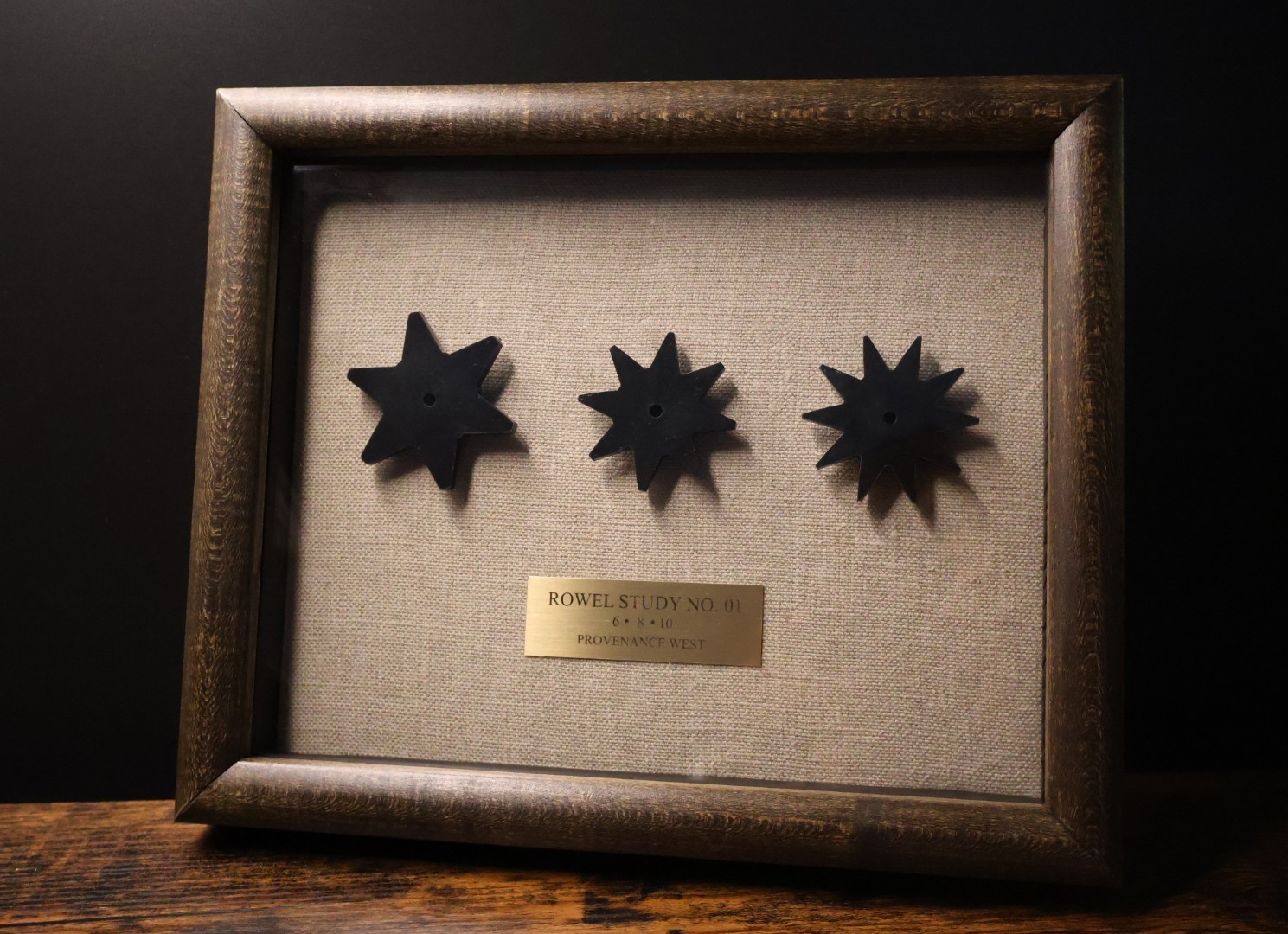
A Study of 6, 8, and 10-Tooth Spur Rowels
The Geometry of the Rowel
A Study of 6, 8, and 10-Tooth Spur Rowels
Provenance West
Provenance West
Object Studies - Frontier Objects
The 6-Point Rowel
Authority Through Contact
The 6-point rowel is the most deliberate of the three.
With fewer, more widely spaced points, each contact with the horse is distinct
and legible. There is no diffusion of pressure—only clear communication.
Historically, this form was favored where responsiveness mattered more than refinement.
It is not aggressive. It is exact.
The geometry demands discipline from the rider. Every movement
is felt. Nothing is hidden.
Within the Provenance West study, the 6-point rowel represents the earliest
principle of the tool: clarity over comfort, signal over softness.
The 8-Point Rowel
The Balance of Use
The 8-point rowel is equilibrium.
Neither too sparse nor too dense, it distributes contact in a way that allows
for both responsiveness and smoothness. It became one of the most commonly
used forms not because it was average but because it was adaptable.
It is the working geometry of the West.
This is the rowel of long days, varied terrain, and riders who required consistency
above all else. It does not announce itself. It performs.
In the Provenance West study, the 8-point rowel represents continuity, the form
that endured because it worked.
The 10-Point Rowel
Refinement Through Density
The 10-point rowel introduces a different philosophy.
With increased point density, contact becomes more continuous, more fluid.
The signal softens not in strength, but in delivery. It allows for a level of
nuance that reflects a more refined riding style.
This is not a beginner’s tool.
It requires control to be effective. In untrained hands, it becomes meaningless.
In skilled use, it becomes nearly invisible.
Within the study, the 10-point rowel represents progression, the movement
toward precision without harshness.
The Rowel as Object
Removed from the spur and presented in isolation, the rowel reveals something
often overlooked:
It is a pure study in proportion.
Diameter, tooth count, spacing, and edge definition all work together
to determine behavior. When reduced to its essential form, it becomes less
a tool and more a record of decision-making.
Each variation is a different answer to the same question:
How should a rider communicate with a horse?
The Provenance West Rowel Study
The Provenance West Rowel Study is not a reproduction.
It is a distillation.
Each 6, 8, and 10-point rowel is produced with strict attention to geometry, proportion
Presented as a study set, these pieces are intended to be observed, compared, and understood.
This is not about nostalgia.
It is about recognizing that even the smallest objects of the West were shaped by discipline, not decoration.
Acquisition
To acquire one is not to purchase décor.
The Rowel Study is released in limited quantities.
Each set is produced in small runs and presented as a complete study of form; 6, 8, and 10-point
geometries preserved as objects of reference.
Acquisition is offered through direct inquiry.
The 6-Point Rowel
Authority Through Contact
The 6-point rowel is the most deliberate of the three.
With fewer, more widely spaced points, each contact with the horse is distinct
and legible. There is no diffusion of pressure—only clear communication.
Historically, this form was favored where responsiveness mattered more than refinement.
It is not aggressive. It is exact.
The geometry demands discipline from the rider. Every movement
is felt. Nothing is hidden.
Within the Provenance West study, the 6-point rowel represents the earliest
principle of the tool: clarity over comfort, signal over softness.
The 8-Point Rowel
The Balance of Use
The 8-point rowel is equilibrium.
Neither too sparse nor too dense, it distributes contact in a way that allows
for both responsiveness and smoothness. It became one of the most commonly
used forms not because it was average but because it was adaptable.
It is the working geometry of the West.
This is the rowel of long days, varied terrain, and riders who required consistency
above all else. It does not announce itself. It performs.
In the Provenance West study, the 8-point rowel represents continuity, the form
that endured because it worked.
The 10-Point Rowel
Refinement Through Density
The 10-point rowel introduces a different philosophy.
With increased point density, contact becomes more continuous, more fluid.
The signal softens not in strength, but in delivery. It allows for a level of
nuance that reflects a more refined riding style.
This is not a beginner’s tool.
It requires control to be effective. In untrained hands, it becomes meaningless.
In skilled use, it becomes nearly invisible.
Within the study, the 10-point rowel represents progression, the movement
toward precision without harshness.
The Rowel as Object
Removed from the spur and presented in isolation, the rowel reveals something
often overlooked:
It is a pure study in proportion.
Diameter, tooth count, spacing, and edge definition all work together
to determine behavior. When reduced to its essential form, it becomes less a tool and more a record of decision-making.
Each variation is a different answer to the same question:
How should a rider communicate with a horse?
The Provenance West Rowel Study
The Provenance West Rowel Study is not a reproduction.
It is a distillation.
Each 6, 8, and 10-point rowel is produced with strict attention to geometry and proportion.
Presented as a study set, these pieces are intended to be observed, compared, and understood.
This is not about nostalgia.
It is about recognizing that even the smallest objects of the West were shaped by discipline, not decoration.
Acquisition
To acquire one is not to purchase décor.
The Rowel Study is released in limited quantities.
Each set is produced in small runs and presented as a complete study of form; 6, 8, and 10-point
geometries preserved as objects of reference.
Acquisition is offered through direct inquiry.
The 6-Point Rowel
Authority Through Contact
The 6-point rowel is the most deliberate of the three.
With fewer, more widely spaced points, each contact with the horse is distinct and legible. There is no diffusion of pressure—only clear communication. Historically, this form was favored where responsiveness mattered more than refinement.
It is not aggressive. It is exact.
The geometry demands discipline from the rider. Every movement is felt. Nothing is hidden.
Within the Provenance West study, the 6-point rowel represents the earliest principle of the tool: clarity over comfort, signal over softness.
The 8-Point Rowel
The Balance of Use
The 8-point rowel is equilibrium.
Neither too sparse nor too dense, it distributes contact in a way that allows for both responsiveness and smoothness. It became one of the most commonly used forms not because it was average but because it was adaptable.
It is the working geometry of the West.
This is the rowel of long days, varied terrain, and riders who required consistency above all else. It does not announce itself. It performs.
In the Provenance West study, the 8-point rowel represents continuity, the form that endured because it worked.
The 10-Point Rowel
Refinement Through Density
The 10-point rowel introduces a different philosophy.
With increased point density, contact becomes more continuous, more fluid. The signal softens not in strength, but in delivery. It allows for a level of nuance that reflects a more refined riding style.
This is not a beginner’s tool.
It requires control to be effective. In untrained hands, it becomes meaningless. In skilled use, it becomes nearly invisible.
Within the study, the 10-point rowel represents progression, the movement toward precision without harshness.
The Rowel as Object
Removed from the spur and presented in isolation, the rowel reveals something often overlooked:
It is a pure study in proportion.
Diameter, tooth count, spacing, and edge definition all work together to determine behavior. When reduced to its essential form, it becomes less a tool and more a record of decision-making.
Each variation is a different answer to the same question:
How should a rider communicate with a horse?
The Provenance West Rowel Study
The Provenance West Rowel Study is not a reproduction.
It is a distillation.
Each 6, 8, and 10-point rowel is produced with strict attention to geometry, proportion, and edge clarity, removing ornament to focus entirely on form. Presented as a study set, these pieces are intended to be observed, compared, and understood.
This is not about nostalgia.
It is about recognizing that even the smallest objects of the West were shaped by discipline, not decoration.
Acquisition
To acquire one is not to purchase décor.
The Rowel Study is released in limited quantities.
Each set is produced in small runs and presented as a complete study of form; 6, 8, and 10-point geometries preserved as objects of reference.
Acquisition is offered through direct inquiry.